Quiet luxury: how to tell a well-made piece from an expensive one
Six checks that separate genuinely well-made clothing from expensive packaging — the shoulder seam, the lining, the grain, and what to feel for.
We earn a commission if you buy through our links — and we buy everything we write about, at full price. That is the whole deal.
Quiet luxury became a marketing category the moment it became a search term, which means a great deal of expensive, beige, badly made clothing is now sold under the label. The useful version of the idea is not an aesthetic at all — it is a short list of construction checks you can run in a fitting room, on anything, at any price.
Hold it by one shoulder
This is the fastest test there is. Lift the garment by a single shoulder and let it hang. Cloth cut on-grain falls straight down. Cloth cut off-grain — which manufacturers do to squeeze more pieces from a roll — twists visibly to one side. A twisted piece will never hang correctly on a body, and no alteration fixes it, because the fault is geometry rather than fit.
Find the shoulder seam
On a structured piece the seam should sit exactly on the corner of your shoulder. If it has already slid down your arm on the hanger, the jacket has no internal structure holding its line, and a season of wear will collapse what shape it has. This single detail separates tailoring that reads expensive from tailoring that reads costume, almost regardless of price.
Turn it inside out
Seam allowances should be wide enough to let out — a centimeter and a half or more. Raw, overlocked edges pressed flat mean the garment was never designed to be altered or to survive many washes. A lining should be stitched in and hang free at the hem, not glued or tacked flat against the shell.
Squeeze a handful and let go
Ball a section of fabric in your fist, hold for five seconds, release. Dense, well-finished cloth relaxes and drops most of the creasing within a minute. Loose, under-finished cloth keeps every wrinkle. This tells you more about how a piece looks at four in the afternoon than any fiber label does.
Check the pattern across a seam
On anything striped, checked or printed, look at where two panels meet. Matching a pattern costs fabric and cutting time, so it is one of the most reliable signals that a maker was not economizing. Nothing gives away a corner-cut garment faster than a stripe that jumps at the side seam.
Read the fiber label second, not first
Natural is not automatically better. A dense engineered blend often beats a loosely woven pure wool for shape retention and wrinkle recovery. Weave density and cut decide how a garment behaves; the fiber name only sets the ceiling. Run the physical checks first, then read the label to understand what you are dealing with. If the label says wool, cashmere or merino, our breakdown of what each fiber is actually good at is worth five minutes before you decide the premium is justified.
The fastest way to see all of this applied at once is our Janet Howard edit — every piece on that list passed the checks above, and we say exactly where.
What the label actually tells you, and what it hides
A composition label gives you fiber percentages and nothing about quality, and the difference matters more than almost anyone realizes. "100% cashmere" covers both a dense two-ply knit that will outlive you and a loose single-ply that pills into a mess by February. The fiber is identical. The construction is not.
Two things on the label are genuinely useful. Country of manufacture is a weak signal but not a useless one — certain regions have deep specialist traditions, though a good factory anywhere beats a poor one somewhere famous. And "dry clean only" on a simple cotton or wool piece is often a sign the maker has not tested it rather than a genuine requirement.
The five-minute in-shop check
In order, because each takes seconds and each rules out a whole category of problems.
Hold it up by one shoulder. It should hang dead straight. Twisting means it was cut off-grain to save fabric, and no alteration fixes it.
Look through it. Hold the fabric to a light. A dense weave blocks most of it. If you can read the shape of your hand clearly through a winter coat, the cloth is thin.
Scrunch a corner in your fist for five seconds and let go. Good cloth releases most of the creasing on its own. This is the fastest wrinkle-recovery test there is.
Check the pattern across a seam. Stripes and checks that line up cost more fabric and more skill. Misalignment at a side seam is the clearest signal a maker was economizing where they thought you would not look.
Pull gently at a seam. You should not see the stitching gap or a flash of white thread base. If you do, the seam allowance is too narrow, and it will fail there.
Where paying more is genuinely worth it
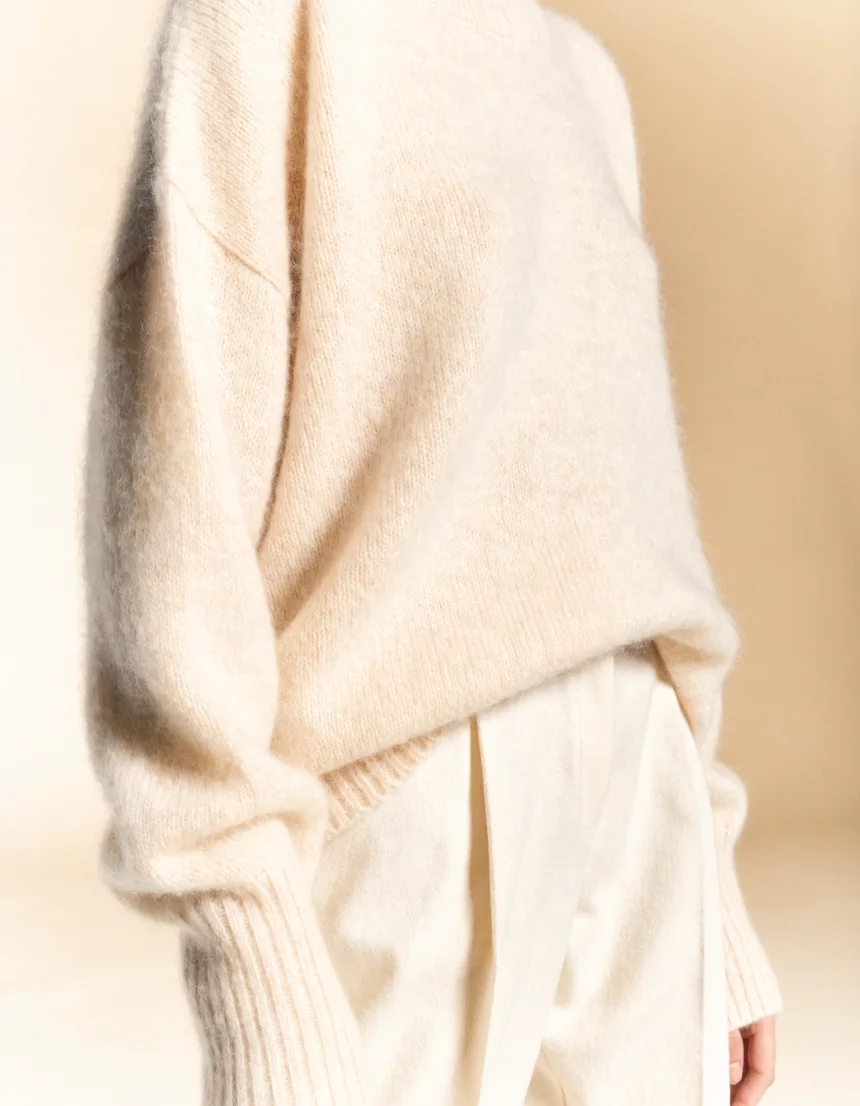
Outerwear, first and by a distance — it is the piece that gets the most wear, takes the most weather, and is the thing people actually see. Then anything tailored, because the shoulder is the one part of a garment a tailor cannot meaningfully rescue. Then knitwear, where density is the whole story and cheap density does not exist.
Where it is mostly wasted: t-shirts, which have a genuine ceiling; anything trend-shaped that you will not want in three years; and heavily embellished pieces, where you are paying for decoration rather than construction.
The one thing nobody mentions
Buttons. Replaceable, cheap, and the single fastest way to make an inexpensive coat read as expensive. Corozo or horn instead of plastic costs a few pounds and changes the whole register of a piece. It is the only upgrade on this list you can do after buying.